

PCI DSS v4.0.1 · ISO/IEC 27001:2022 · NIST CSF 2.0 · SOC 2 (Trust Services Criteria) · GDPR (EU 2016/679)
Audit the facility you actually have — whether that is a Tier IV data centre or a cupboard with three servers in it.
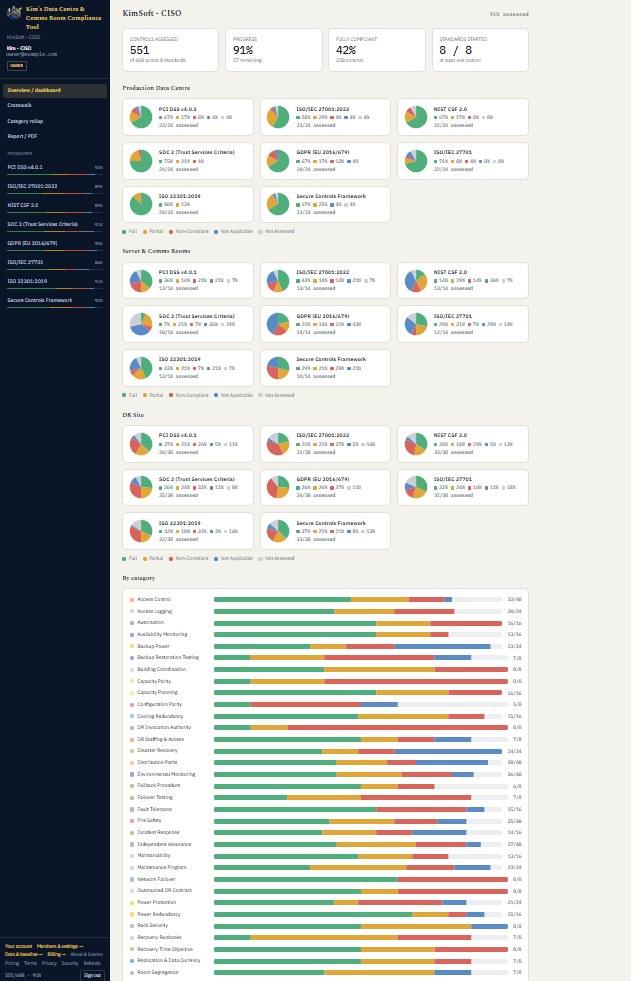
Every physical requirement from 8 standards, banded by Uptime Institute Tier I–IV, with separate scopes for server, comms and network rooms and for the DR site — 76 checkpoints, each one carrying the clause reference for all eight.
Built for data centre and facilities managers, IT leads who own a server room, and the auditors who review them.
Kim's Data Centre & Comms Room Compliance Tool
No card needed. Free for 5 days; after that the workspace is read-only until you subscribe. Already have an account? Sign in.
What changes
One workspace instead of eight trackers
Before
- A Tier IV checklist handed to a room with one rack in it
- Eight standards asking the same physical question eight ways
- No defensible way to say a requirement does not apply here
- A Tier IV production site quietly failing over to a Tier I recovery site
- Redundancy findings raised against sites that were never built for it
- Photographs and permits scattered across phones and mailboxes
- The same site walk repeated for every framework, every year
After
- Requirements banded by tier, so you assess the level you are built to
- A room scope that states what still applies, what reduces and what does not, and a DR scope that asks whether recovery actually works
- One verdict per physical control, carried to all eight standards at once
- Every exclusion recorded with its reason, ready for the auditor to read
- Evidence attached once and followed through the map
- A board-ready PDF and an evidence pack in two clicks
See it
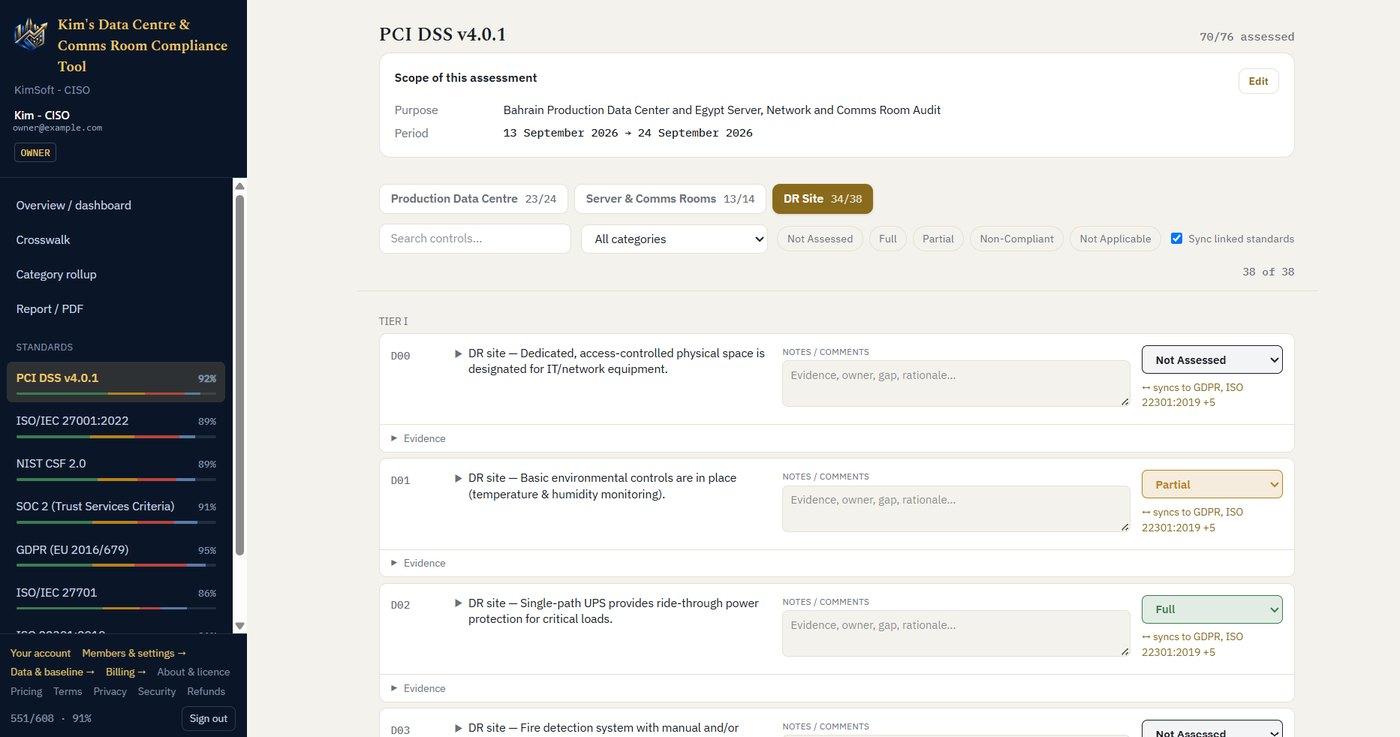
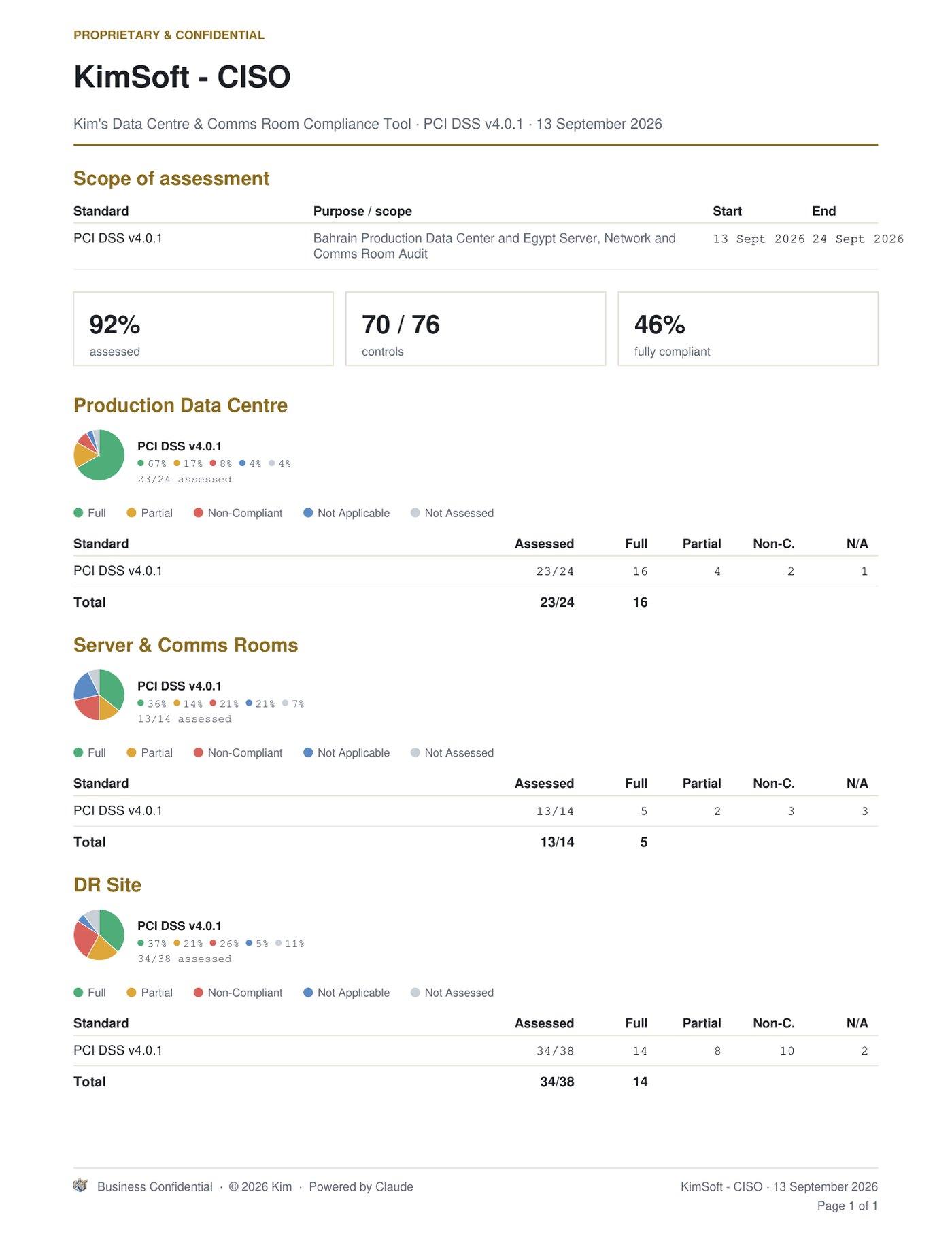
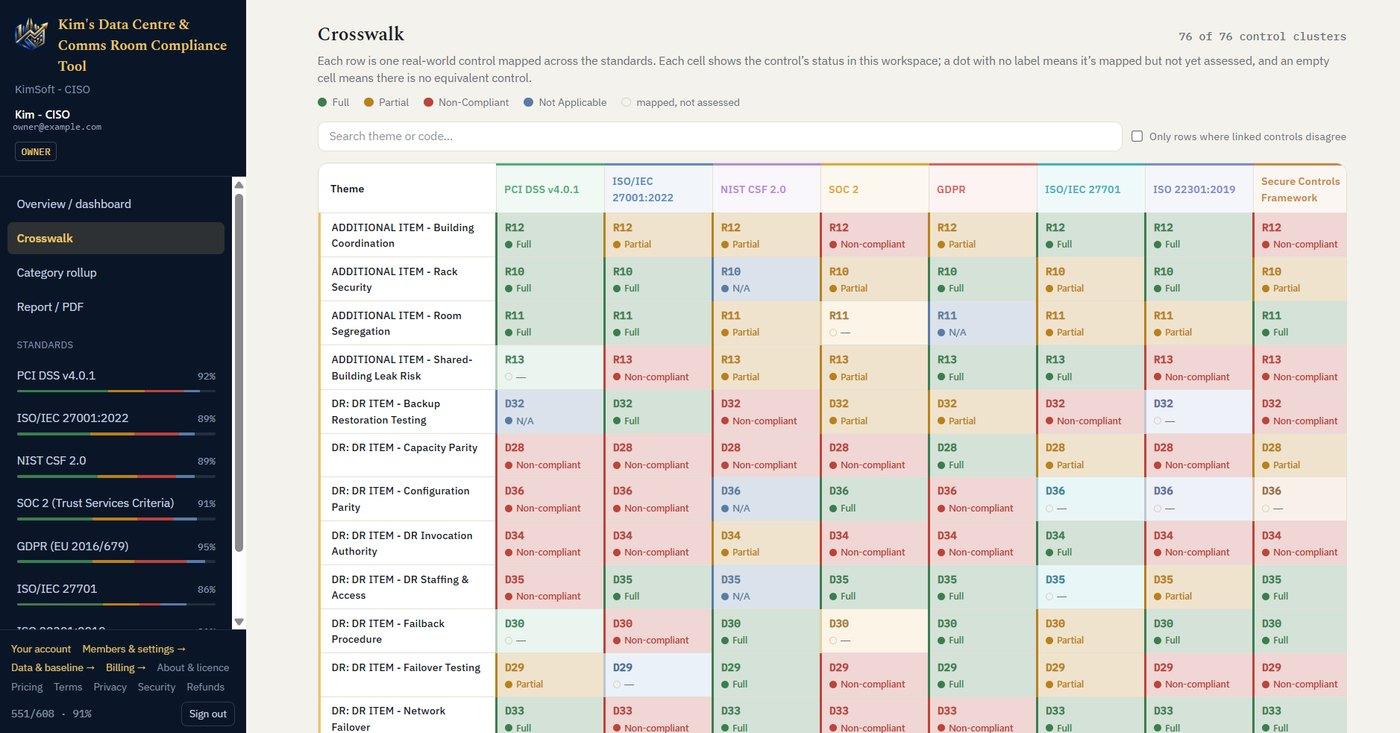
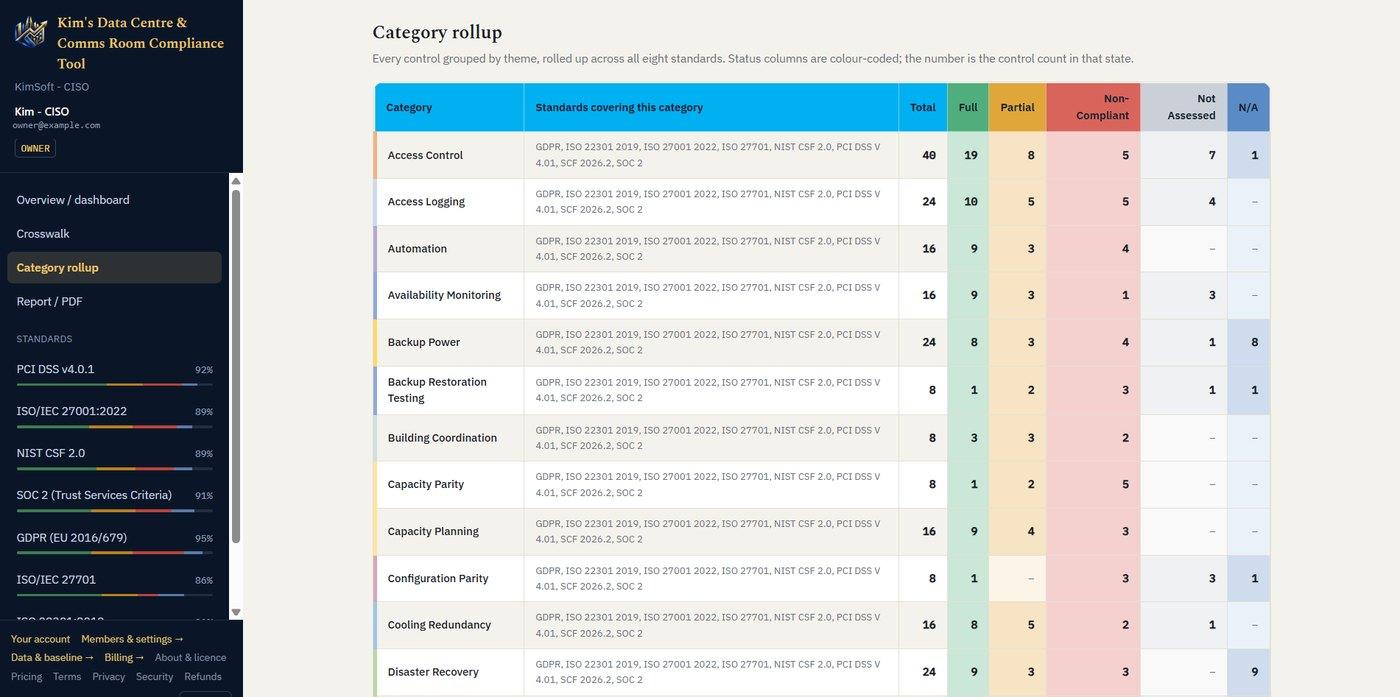
The product, not a mock-up
Screens from a live workspace mid-assessment.
Who it is for
Built for the teams that carry the obligation
Small offices and single comms rooms
You do not need a generator, a second power path or a disaster recovery site — and this says so in writing. The room scope marks those Not Applicable with the reasoning attached, keeps the five controls that genuinely still apply, and adds four a large data centre never thinks about: rack locks, room segregation, coordination with the host building, and leak risk from the floor above.
Growing businesses with a server room
Tier I and II cover single-path power, environmental monitoring, fire detection, access logging and the first layer of redundancy — the things a site earns as it grows, in the order it earns them.
Enterprise and Tier III–IV facilities
Concurrent maintainability, fault tolerance, multiple active distribution paths, automated fault isolation and independent assurance — assessed once and reported against all eight standards together.
Colocation and managed service providers
A separate workspace per site or per client, isolated and billed on its own, with reports that carry your customer's branding rather than ours.
Auditors and consultants
Walk the site once. The tier band tells you what to expect, the room scope tells you what to leave alone, the DR site is scored on its own, and the clause reference for all eight standards sits on the same row.
Why it is different
Not another control spreadsheet with a login
- Scoped to the site, not to the biggest possible site — Uptime Tier I–IV bands, a room scope that marks requirements Not Applicable with the reason recorded, and a DR scope assessed and reported separately.
- A complete crosswalk: the 76 checkpoints expand to 608 rows — one per standard — so a verdict set once lands on all eight. Nothing is left unmapped.
- Physical and environmental controls specifically — power, cooling, fire, access, surveillance, maintenance — rather than a general security framework with a facilities annex.
- Evidence follows the map. Attach a file once and it appears on every linked control.
- Baseline push: work your strongest framework end to end, then apply it across the crosswalk in a single action. Manual overrides are preserved.
- Multi-tenant SaaS with database-enforced isolation, mandatory two-factor authentication, and no card data on our servers.
- White-label reporting: your logo, your header and footer, on every page.
Who built it
Founder-led, practitioner-built

“I built this after years of running the same controls through a different spreadsheet for every framework, rulebook and standard. It is designed, maintained and supported by me, from the Kingdom of Bahrain.”
— Kim · kim_abdalian@yahoo.com
Pricing
Priced per seat, with nothing held back
$500
per seat / year
- No minimum — buy a single seat at $500 / year
- Add or remove seats one at a time, pro-rated
- Seats reassignable for the whole term
- 5-day free trial, cancel any time
- Every feature included — no tiers, no add-ons
What it replaces
- The eight spreadsheets one programme usually runs on, one per framework
- The hand-built cross-mapping between them, and the drift that follows
- The scramble to assemble an evidence pack at audit time
- The 76 shared requirements you would otherwise map by hand
Security & architecture
Built to be looked at by the people you answer to
Tenant isolation in the database
Every row carries an org id and PostgreSQL Row-Level Security enforces it. A query that forgets the filter returns nothing, not someone else's data.
Evidence in a private bucket
Never public. Files are served through signed URLs that expire in 60 seconds.
Encrypted in transit and at rest
TLS 1.2 or better on the wire, AES-256 at rest.
Two-factor authentication, mandatory
Every account, no exception, with a 30-minute idle timeout and 90-day password rotation.
Backed up daily, with point-in-time recovery
So a bad afternoon is recoverable, not a rebuild.
Hosted in the EU
Frankfurt (eu-central-1). Evidence and assessment data stay in the region.
Sessions end on their own
A 30-minute idle timeout, shared across open tabs, so an unattended screen does not stay signed in.
No card data on our servers
Payments are taken by Lemon Squeezy as Merchant of Record, which also handles global VAT and sales tax.
Questions
Asked before you have to ask them
We have one comms room, not a data centre. Is this for us?
Yes — that case is built in rather than bolted on. The room scope classifies every requirement as Still Applies, Reduced Scope, Not Applicable or Additional Item. Dual power distribution paths, an on-site generator and a separate disaster recovery facility are marked Not Applicable with the reasoning recorded; formal third-party Tier certification reduces to an internal facility risk review. Four items appear that a large data centre never needs: lockable racks, room segregation and signage, coordination with the host building's fire and electrical systems, and leak risk from shared plumbing or the floor above.
How is the DR site handled?
As a third audit scope, scored and reported on its own. The 8 standards are re-asked about the recovery site - it has its own tier, usually lower than the production site, and the gap between the two is the finding an auditor is looking for. Fourteen further checkpoints have no primary-site equivalent and cover whether recovery actually works rather than what the building is made of: separation from the primary risk zone, independent utilities, replication and achieved RPO, recovery time against target, capacity parity, failover and failback testing, runbooks reachable without the primary site, restore testing, network cutover, who is authorised to invoke, access that still works when the primary is dark, configuration drift, and what an outsourced DR contract actually guarantees during a regional event.
Do we need to be Uptime Institute certified?
No. The Tier I–IV bands are used as a scoping ladder, not a certification claim. Each tier carries its own definition on every row, so you assess against the level your site is genuinely built to and record the rest as out of scope. Nothing here asserts a certified tier rating.
How complete is the crosswalk?
Complete. There are 76 distinct checkpoints; each is carried across every standard, which is what makes the library 608 rows. Each checkpoint holds the clause reference for all eight, so setting one to Full lands the same verdict on the other 7. That mapping was built by hand from the standards' own physical-security clauses.
What is actually covered — cyber, or the building?
The building and the room. Access control and logging, surveillance, environmental monitoring, power protection and redundancy, cooling, backup power, fire detection and suppression, distribution paths, concurrent maintainability, fault tolerance, capacity planning, disaster recovery, incident response and independent assurance — as each of the eight standards words them.
How is evidence stored?
In a private bucket, never public. A file is served through a signed URL that expires in 60 seconds, so a copied link is useless a minute later. Attach a file to one control and it appears on every crosswalk-linked control in the other standards, tagged with where it came from; remove it once and it is gone everywhere.
Can we export everything?
Yes, and without asking us. A board-ready PDF, a CSV of any selection of standards, and an evidence pack as a ZIP with every attached file foldered by standard and control plus a manifest. There is no lock-in: your assessment data leaves in open formats whenever you want it.
How does tenant isolation work?
Every row carries an org id and PostgreSQL Row-Level Security enforces it in the database, not in application code. A query that forgets the filter returns nothing rather than someone else's data. Server Actions re-check role and membership on every write.
What happens when a standard is revised?
The control library is reference data maintained centrally and shipped to every workspace. Your statuses, notes and evidence are yours and are never touched by an update.
What if someone leaves?
Seats are reassignable for the whole term. Remove a member and the seat frees immediately for the next person, at no extra cost.
Start with your strongest standard. The rest follows.
5 days free with every feature on. Work one standard end to end, push it across the crosswalk, and see the others move.
Prefer to talk first? kim_abdalian@yahoo.com · WhatsApp +973-3671-9993
Made in Bahrain · Serving the GCC and beyond · Founder-led, practitioner-built
Covering: PCI DSS v4.0.1 · ISO/IEC 27001:2022 · NIST CSF 2.0 · SOC 2 (Trust Services Criteria) · GDPR (EU 2016/679) · ISO/IEC 27701 · ISO 22301:2019 · Secure Controls Framework.
© 2026 Kim. All rights reserved.
“Kim's Data Centre & Comms Room Compliance Tool” and its structure, control taxonomy, category framework, and cross‑standard crosswalk mappings are the proprietary intellectual property of Kim. Unauthorized copying, reproduction, distribution, sublicensing, or resale — in whole or in part — is strictly prohibited without prior written consent. Access is licensed, not sold, subject to the accompanying End User Licence Agreement.
Contact Kim · kim_abdalian@yahoo.com · +973-3671-9993

Pricing · Terms of Service · Privacy Policy · Refund Policy · Security Policy